
How InDesign Typesetting Services Improve Publishing Quality

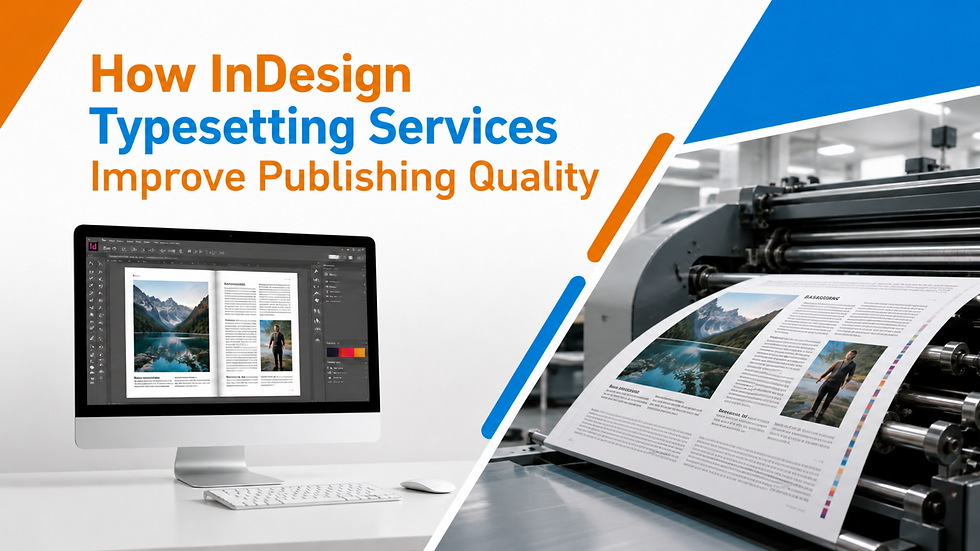
The authors are more concerned with the proper formatting and styling of the book after their manuscript is ready for publication. However, is there anything worse than completing the process of writing a book, catalog, magazine, or other publication and being disappointed by the final unprofessional look?
Badly formatted text, spacing, fonts, and page layout can completely ruin an otherwise good piece of content. That is why InDesign typesetting services play such an important role in improving the publishing quality. Indeed, modern publishing is highly competitive.
Readers are used to seeing professional publications that look impressive and are easy to read. According to Adobe statistics, InDesign is one of the most popular publishing and page layout software on the market. Nowadays, high-quality typesetting services are essential in the publishing industry, especially for publishing magazines, books, newsletters, or journals. This blog will explore the importance of InDesign typesetting services and how they improve publishing quality.
Importance Of Professional Typesetting In The Publishing Industry
Some authors believe that good content is enough to succeed. This statement is partially true, but the publishing industry is also about the way content is arranged. Typesetting means arranging text, graphics, images, and other material in a specific layout to make the whole thing look professional and attractive.
The benefits of using professional typesetting services are:
Making the whole publication easy to read.
Avoiding various typesetting errors.
Maintaining consistent and appropriate placement of graphics.
Achieving smooth page flow.
Ensuring consistent typography.
Avoid uneven spacing.
Using typesetting services is a good opportunity to make publications more effective.
Role Of Adobe InDesign In The Publishing Industry Today
InDesign is one of the most widely used publishing applications. With InDesign, designers create compelling designs for books, reports, journals, magazines, and many more. By using this application, publishers can:
Produce digital publications with correct formatting.
Work on print-ready book formatting.
Apply correct page settings.
Place images according to their needs.
Manage multi-page documents.
Format text and images appropriately.
InDesign becomes an essential part of publishing processes.
Improves Readability Using Advanced Typography
It is hard to underestimate the significance of typography in the publishing industry. It directly influences the reader's experience. But many people cannot enjoy reading well-written text because of poor typography.
Professional typography services will help to solve this problem. With the help of InDesign, it is possible to confirm:
Professional visual representation.
Improved readability.
Correct format of subheadings and headings.
Proper visual hierarchy.
Smooth text flow.
All of these elements help the readers enjoy reading the material.
Ensures Consistency Of Publications
Another aspect worth paying special attention to is publication consistency. Publications must look uniform across fonts, pages, and other elements. Professional editorial layout services will help to maintain consistency by creating InDesign templates. As a result, the publication will demonstrate:
Professional visual look.
Strengthened brand identity.
Increased readers’ experience.
Improved publication quality.
InDesign makes it easier to produce high-quality publications.
Helps To Prepare Files For Printing
When preparing files for final printing, many factors should be considered. For example, all pages must have appropriate margins, page dimensions, and image resolutions. That is why it is recommended to use professional eBook typesetting services to create print-ready book formatting.
With the help of InDesign, designers will easily perform all these tasks:
Improving layout quality.
Creating print-ready files.
Managing bleed areas.
Setting up print specifications.
Adjusting colors and other settings.
These advantages allow the entire printing process to be faster and simpler.
Makes Publications Suitable For Being Published Online
Many authors use online resources nowadays. That is why it is important not only to arrange publications properly but also to prepare files for online publication.
InDesign makes it possible to develop publications that will work fine when published online. In particular, InDesign will help to develop:
Interactive PDF publications.
eBooks.
Digital magazines and journals.
Other types of digital publications.
Such an approach guarantees that the quality of online publications is preserved.
Facilitates Publishing Process
Publishing is usually a complicated process. One can work with many different people to create a publication: designers, editors, authors, proofreaders, and more.
Thus, it is quite difficult to keep everything under control. The role of InDesign is to facilitate publishing processes. With its help, people managing the project will benefit from:
Better collaboration.
Quick revision opportunities.
Fast content updates.
Reducing the time needed to complete publishing projects. In this way, the publishing project becomes easier to manage.
Provides Publishers with Customized Solutions
Every publisher wants to create unique products for their target audience. Indeed, different publications require certain layout approaches. The main task of professional page layout design services is to provide their customers with customized solutions.
InDesign makes it possible to create:
Magazine layouts that attract the target audience.
Book layouts that represent the publisher’s brand.
Academic journal layouts, and so forth.
In this way, a publication becomes recognizable and distinctive.
Helps Publishers Avoid Mistakes In The Text Layout
Formatting errors may spoil the whole publication. For example, the publication will contain inconsistent page numbering, misplaced graphics, and other errors that distract readers. That is why checking and proofreading are important steps of a publishing workflow.
Typesetting aims to avoid those errors in the first place. InDesign allows typesetters to avoid:
Different types of formatting mistakes.
Incorrect page numbering.
Errors in page styling.
Wrong positioning of images.
A publication becomes neat and professional.
Helps Publishers Satisfy All Quality Requirements Of The Publishing Market
Quality standards keep changing because readers’ preferences constantly evolve. That is why publishers should now pay close attention to factors such as readability, design quality, printing preparation, and digital publishing.
Professional publication design and typesetting services confirm that all these aspects are considered. In addition, it helps to comply with industry standards.
Increase the Reading Experience Of An eBook by Using Typesetting Services
Good content requires an equally professional presentation. Though the importance of good writing cannot be overstated, typesetting, formatting, and proper layout design help readers interact with the content effectively. InDesign typesetting services provide publishers with the tools needed to ensure their publications look professional and offer an excellent reading experience.
This process can involve everything from page and manuscript layout design and formatting to digital publishing and the optimization of the entire publishing process. By utilizing professional typesetting services and consulting professional book typesetting specialists, publishers will not only improve their work but also improve their brand image.
Comments